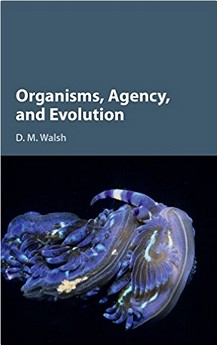

Denis M. Walsh received his PhD in Biology from McGill University, Montréal (systematics of the caecilians). He subsequently studied Philosophy at King's College Cambridge, and then on to King's College London, where he completed the MPhil and PhD (modal logic and modal metaphysics). He was awarded a Social Sciences and Humanities Research Council (Canada) Post-doctoral fellowship, which he took at The University of Madison-Wisconsin, under the supervision of Professor Elliott Sober. It was here that he began to synthesise his interests in evolutionary biology and philosophy. He has taught philosophy primarily at The University of Edinburgh and The University of Toronto, with shorter stints at the London School of Economics, Dartmouth College, and MIT.
Walsh has pioneered and defended the so-called 'statistical' interpretation of evolutionary population dynamics, according to which traditional Modern Synthesis models of evolution identify statistical parameters that predict and explain evolutionary population change, but do not articulate the causes of population change. He develops the view that (perhaps uniquely) evolutionary theory deploys three distinct modes of explanation—causal, statistical, and teleological. Orthodox philosophical opinion, however, holds that the only genuine scientific explanations are causal. Walsh articulates a generalised account of scientific explanation in which causal, statistical, and teleological explanations are all legitimate variants (modes). He uses this conception of explanation to develop an account of the place of organisms, as natural purposive entities, in evolutionary processes. Organisms, on this view, are agents of evolutionary change, and not simply its objects.